AI-Powered Autonomous Enterprise: The Future of SAP

For decades, businesses have invested in technology to improve efficiency, automate workflows, and gain better visibility into operations. Yet many organizations still rely on manual interventions, disconnected systems, and time-consuming decision-making processes.

Today, that is changing rapidly.

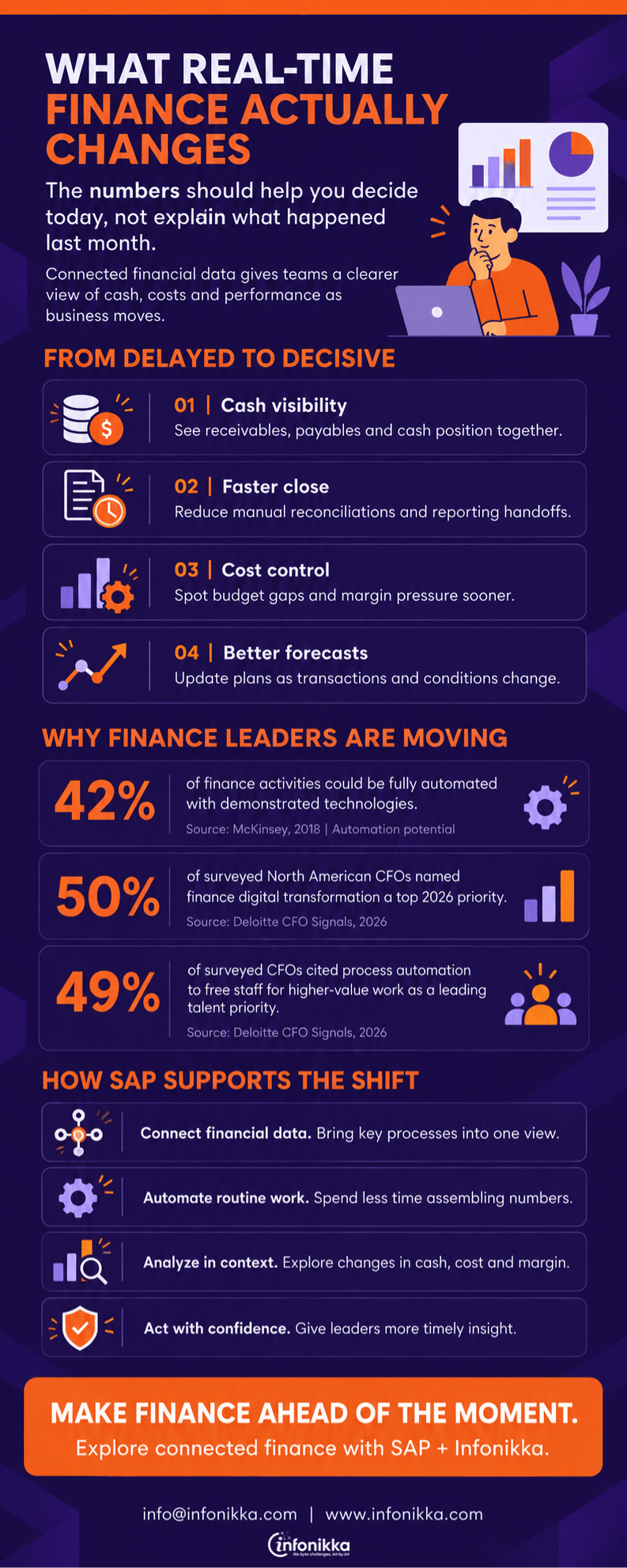
With the introduction of SAP Business AI, Joule, AI agents, and intelligent automation, SAP is moving beyond traditional enterprise software and paving the way for the Autonomous Enterprise—a business environment where systems can analyze data, recommend actions, automate routine tasks, and support faster decision-making with minimal human intervention.

What Is an Autonomous Enterprise?

An Autonomous Enterprise uses artificial intelligence, automation, and real-time business data to streamline operations across finance, procurement, supply chain, human resources, and customer engagement.

Instead of employees spending hours searching for information, generating reports, or manually processing transactions, intelligent systems can perform many of these tasks automatically.

The goal is not to replace people. The goal is to free teams from repetitive work so they can focus on strategy, innovation, and customer value.

SAP Business AI and Joule: The Foundation of Intelligent Operations

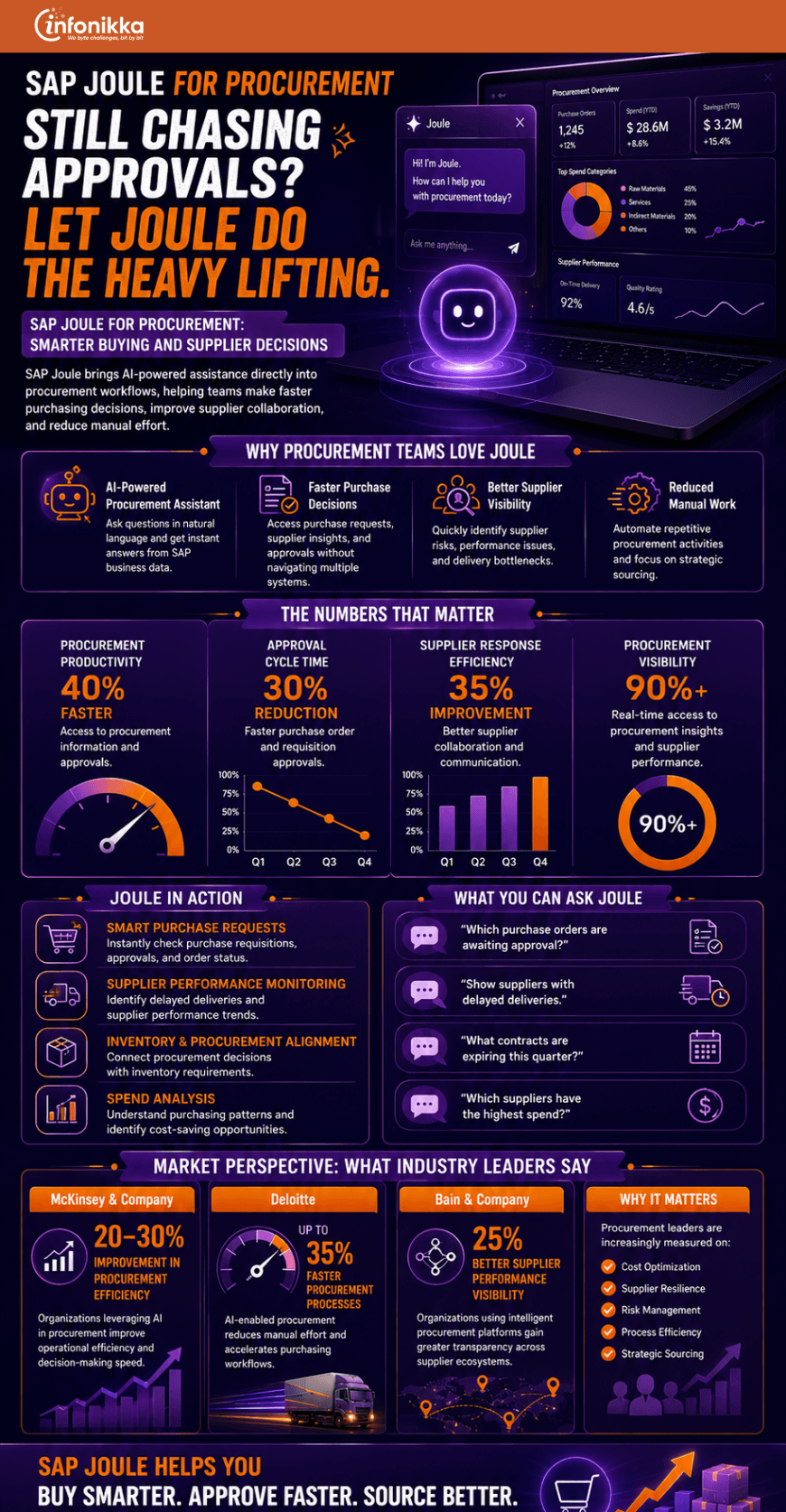
At the center of SAP’s AI strategy is SAP Business AI and Joule, SAP’s generative AI copilot.

Joule helps users interact with SAP applications through natural language. Employees can ask questions, generate insights, summarize information, and perform business actions without navigating multiple screens or reports.

For example:

  • Finance teams can quickly analyze spending patterns.
  • Procurement teams can identify sourcing risks.
  • HR teams can streamline employee requests.
  • Supply chain teams can respond faster to disruptions.

By embedding AI directly into business processes, SAP is making enterprise software more intuitive and productive than ever before.

AI Agents That Work Alongside Employees

The most exciting development is the emergence of AI agents.

Unlike traditional automation tools that follow predefined rules, AI agents can understand context, analyze data, make recommendations, and initiate actions across business processes.

Imagine a supply chain disruption occurring in one region. An AI agent could identify the issue, assess inventory availability, recommend alternative suppliers, estimate financial impact, and notify relevant stakeholders—all within minutes.

This shift from process automation to decision automation is what truly differentiates the Autonomous Enterprise from previous digital transformation initiatives.

Organizations that adopt AI agents early will be better positioned to improve agility, reduce operational costs, and respond faster to market changes.

Why Businesses Are Paying Attention

Companies today face increasing pressure to do more with fewer resources. Rising customer expectations, economic uncertainty, talent shortages, and complex supply chains are forcing organizations to rethink how work gets done.

Autonomous business processes help organizations:

  • Improve operational efficiency
  • Reduce manual errors
  • Accelerate decision-making
  • Increase employee productivity
  • Enhance customer experiences
  • Improve business resilience

As AI capabilities continue to mature, autonomous operations will become a competitive advantage rather than a technology initiative.

How Infonikka Can Help

At Infonikka, we help organizations unlock the full value of SAP investments through consulting, implementation, integration, support, and digital transformation services.

Our SAP experts work closely with clients to identify high-impact automation opportunities, optimize business processes, and prepare enterprise systems for AI-driven innovation.

Whether you are planning an SAP S/4HANA transformation, exploring SAP Business AI, implementing intelligent automation, or building a future-ready data strategy, Infonikka can help you create a roadmap that aligns technology with business outcomes.

The journey to an Autonomous Enterprise is not about adopting AI for the sake of innovation. It is about creating a smarter, more responsive organization that can adapt, grow, and compete in an increasingly dynamic business environment.

The future of SAP is intelligent, connected, and autonomous. The organizations that begin that journey today will be the ones leading tomorrow.


SAP SuccessFactors Analytics: Turning Workforce Data into Business Advantage

People have always been an organization’s greatest asset. Yet many companies still struggle to answer critical workforce questions. Why are employees leaving? Which recruitment channels deliver the best talent? Are engagement levels improving? Do diversity initiatives translate into measurable outcomes? The answers often exist within HR systems, but turning that information into meaningful business insights requires the right tools. This is where SAP SuccessFactors Analytics is helping organizations make smarter workforce decisions through real-time data, predictive insights, and comprehensive people analytics.

Why HR Analytics Matters More Than Ever

The workplace has changed significantly over the past few years. Hybrid work models, talent shortages, evolving employee expectations, and increasing competition for skilled professionals have made workforce management more complex. Business leaders can no longer rely on assumptions when making talent decisions. They need accurate, data-driven insights into hiring performance, employee engagement, workforce productivity, retention risks, and organizational effectiveness. SAP SuccessFactors Analytics provides the visibility organizations need to understand workforce trends and make proactive decisions. Instead of reacting to problems after they occur, HR leaders can identify risks early and take action before they impact business performance.

Key Areas Where SuccessFactors Analytics Creates Value

Recruitment Analytics

Organizations can track every stage of the hiring funnel, including application volumes, interview conversion rates, hiring timelines, and source effectiveness. This helps recruiters identify bottlenecks and improve hiring outcomes.

Attrition Analysis

Employee turnover can be costly and disruptive.

SuccessFactors Analytics helps HR teams monitor attrition trends, identify departments with higher turnover rates, and uncover patterns that may indicate retention risks.

Employee Engagement

Understanding employee sentiment is essential for maintaining a productive workforce.

Analytics dashboards provide visibility into engagement scores, survey results, and workforce feedback trends, helping leaders take meaningful action.

Diversity and Inclusion Metrics

Organizations can measure workforce diversity across departments, leadership levels, locations, and hiring programs.

This supports transparency and helps businesses track progress against diversity objectives.

Workforce Planning

By combining workforce data with business goals, organizations can make better decisions regarding hiring, succession planning, skills development, and resource allocation.

Predictive Workforce Intelligence

The real value of modern HR analytics lies in prediction rather than reporting. Traditional HR reports tell organizations what happened. Predictive analytics helps organizations understand what might happen next. Imagine being able to identify employees who may be at risk of leaving, forecast future hiring needs, predict skills shortages, or detect engagement challenges before they impact productivity. This shift from workforce reporting to workforce intelligence is becoming a major competitive advantage. Organizations that use predictive insights can make better talent decisions, improve employee experiences, and build stronger, more resilient workforces.

HR Is Becoming a Strategic Function

Today’s HR teams are expected to contribute directly to business growth. Leadership teams want workforce decisions backed by measurable data rather than assumptions. SAP SuccessFactors Analytics helps HR leaders connect workforce performance with broader business objectives, creating greater alignment between people strategy and organizational success. The result is better decision-making, stronger employee experiences, and improved business outcomes.

How Infonikka Can Help

At Infonikka, we help organizations maximize the value of SAP SuccessFactors through consulting, implementation, integration, optimization, and ongoing support services. Our SAP experts work closely with clients to build customized HR analytics frameworks, create meaningful dashboards, improve reporting accuracy, and enable data-driven workforce strategies. Whether you are implementing SAP SuccessFactors, modernizing HR operations, improving employee engagement, or building predictive workforce analytics capabilities, Infonikka can help you transform workforce data into actionable business insights. The future of HR is no longer based solely on experience and intuition. It is increasingly driven by data, analytics, and intelligent workforce planning. Organizations that embrace people analytics today will be better positioned to attract, retain, and develop the talent needed for tomorrow.

To learn more about our SAP Services, visit our website: SAP Consulting Services | SAP Implementation Partner – Infonikka

Sustainable ERP: How SAP Helps Organizations Meet ESG Goals

Sustainability is no longer a topic reserved for annual reports and corporate communications teams. Today, it sits at the center of business strategy. Investors are asking tougher questions. Customers want greater transparency. Regulators are introducing stricter reporting requirements. At the same time, organizations are under pressure to reduce environmental impact while maintaining profitability. The challenge is that sustainability data often lives in multiple systems, spreadsheets, and departments. Without accurate and connected data, tracking carbon emissions, energy consumption, waste generation, and compliance metrics becomes difficult. This is where SAP is helping organizations take a more structured and measurable approach to Environmental, Social, and Governance (ESG) initiatives.

Why ESG Requires More Than Good Intentions

Many organizations have sustainability goals. Fewer have the systems needed to measure progress accurately. ESG success depends on reliable data, real-time visibility, and consistent reporting. Businesses need to understand not only their financial performance but also their environmental and social impact. SAP enables organizations to integrate sustainability metrics directly into core business processes. Instead of treating ESG as a separate initiative, companies can make sustainability part of everyday decision-making. This creates greater accountability and helps leaders make informed choices based on both business and sustainability outcomes.

How SAP Supports Sustainable Business Transformation

SAP provides a range of tools that help organizations monitor, measure, and improve ESG performance.

With SAP Sustainability solutions, businesses can:

  • Track carbon emissions across operations and supply chains
  • Monitor energy consumption and resource usage
  • Improve sustainability reporting accuracy
  • Support ESG compliance requirements
  • Measure progress toward net-zero objectives
  • Improve transparency for stakeholders and investors

Because sustainability data is connected with operational and financial information, leaders gain a more complete picture of business performance. This integrated approach helps organizations move beyond reporting and focus on meaningful action.

AI-Powered Sustainability Intelligence

One of the most exciting developments is the use of artificial intelligence within sustainability programs. Traditional ESG reporting often relies on manual data collection and periodic analysis. AI changes that approach completely. By combining SAP Business AI with sustainability data, organizations can identify inefficiencies, predict environmental risks, automate reporting activities, and uncover opportunities for improvement. For example, AI can analyze procurement data to identify suppliers with higher carbon footprints, recommend alternative sourcing options, and estimate potential sustainability gains. This ability to move from reactive reporting to proactive decision-making is becoming a major competitive advantage for forward-thinking organizations.

Sustainability Is Becoming a Business Requirement

The conversation around ESG has evolved significantly over the last few years. What was once considered a corporate responsibility initiative is now closely linked to risk management, operational efficiency, investor confidence, and long-term business growth. Organizations that can demonstrate measurable sustainability outcomes often gain stronger stakeholder trust, improve operational resilience, and position themselves more effectively in competitive markets. The ability to track and report sustainability performance accurately is becoming just as important as financial reporting.

How Infonikka Can Help

At Infonikka, we help organizations align SAP technology investments with sustainability objectives. Our SAP consulting and implementation experts work with businesses to integrate ESG reporting, automate data collection, improve operational visibility, and build sustainable digital transformation strategies. Whether you are implementing SAP S/4HANA, modernizing business processes, improving sustainability reporting, or exploring AI-powered ESG initiatives, Infonikka can help create a roadmap that delivers measurable business and environmental outcomes. Sustainability is no longer a separate business function. It is becoming a core measure of enterprise performance. With SAP’s sustainability capabilities and the right implementation strategy, organizations can transform ESG goals from aspirations into measurable results.

To know more about SAP Services, visit our website: SAP Consulting Services | SAP Implementation Partner – Infonikka


SAP Joule: Transforming User Productivity Across SAP Applications

For years, enterprise software has helped organizations manage complex business processes. However, one challenge has remained consistent: users often spend too much time searching for information, navigating multiple screens, generating reports, and completing repetitive tasks. SAP is addressing this challenge with Joule, its AI-powered copilot designed to make enterprise applications more intuitive, productive, and user-friendly. Instead of adapting to software, users can now interact with SAP systems using natural language. Whether it’s finance, procurement, human resources, supply chain management, or ERP operations, Joule is changing the way employees work across the SAP ecosystem.

What Is SAP Joule?

SAP Joule is an AI-powered digital assistant embedded within SAP applications. It allows users to ask questions, retrieve information, generate insights, and execute tasks through simple conversational interactions.

Rather than navigating multiple dashboards or running complex reports, employees can ask Joule questions such as:

  • What are the overdue invoices this month?
  • Which suppliers have delivery delays?
  • Show current inventory shortages.
  • Summarize employee turnover trends.
  • Identify purchase orders awaiting approval.

Joule then delivers relevant insights in seconds, helping users make informed decisions faster. The result is a more streamlined and efficient user experience across the enterprise.

How Joule Is Improving Productivity Across Business Functions

Finance

Finance teams can quickly access financial insights, monitor spending trends, review outstanding invoices, and generate summaries without manually searching through multiple reports.

Procurement

Procurement professionals can identify supplier risks, track purchasing activities, review contract performance, and streamline approval processes through conversational requests.

Human Resources

HR teams can access employee information, monitor workforce trends, answer common employee queries, and simplify administrative tasks.

Supply Chain

Supply chain professionals can monitor inventory levels, identify disruptions, analyze logistics performance, and respond more effectively to changing demand conditions.

ERP Operations

Business users across departments can access critical information faster, reducing the time spent navigating complex ERP interfaces and increasing overall productivity.

From Information Access to Intelligent Action

What makes Joule particularly exciting is that it goes beyond simply answering questions. The next phase of enterprise AI is about intelligent action. Imagine a supply chain manager asking Joule about delayed shipments. Instead of only identifying the issue, Joule could recommend alternative suppliers, estimate business impact, generate alerts, and initiate corrective workflows. Similarly, finance teams could receive proactive recommendations on cost-saving opportunities, while procurement teams could be alerted to potential compliance risks before they become business problems. This shift from information retrieval to intelligent business assistance is what sets Joule apart from traditional enterprise software tools. As AI capabilities continue to evolve, organizations will increasingly rely on intelligent assistants to support daily decision-making and operational efficiency.

Why Businesses Are Paying Attention

Organizations today face growing pressure to improve productivity while managing increasingly complex operations. Employees often spend valuable time searching for information rather than acting on it. By reducing manual effort and simplifying user interactions, SAP Joule helps organizations:

  • Improve employee productivity
  • Accelerate decision-making
  • Reduce operational inefficiencies
  • Enhance user adoption of SAP systems
  • Improve employee experience
  • Increase business agility

For many organizations, the value of AI lies not just in automation but in helping people work smarter and faster.

How Infonikka Can Help

At Infonikka, we help organizations maximize the value of their SAP investments through consulting, implementation, integration, optimization, and support services. Our SAP experts work closely with clients to identify opportunities where SAP Business AI and Joule can improve productivity, streamline workflows, and enhance user experiences across business functions. Whether you are implementing SAP S/4HANA, modernizing ERP operations, exploring AI-driven automation, or preparing for future SAP innovations, Infonikka can help create a practical roadmap that aligns technology with measurable business outcomes. The future of enterprise software is becoming more conversational, intelligent, and user-centric. SAP Joule represents a significant step in that journey, helping organizations unlock greater value from their people, processes, and technology investments.

To know more about our SAP Services, visit us at SAP Consulting Services | SAP Implementation Partner – Infonikka


Infographic: Supply Chain Chaos managed by SAP SCM

Modern supply chains face constant pressure from changing customer expectations, rising logistics costs, inventory challenges, and global disruptions. SAP Supply Chain Management (SAP SCM) helps organizations build resilient, connected, and data-driven supply chains that improve operational efficiency and business performance.

By integrating inventory management, logistics, demand planning, warehouse operations, and transportation processes into a unified platform, SAP SCM provides real-time visibility across the entire supply chain. Businesses can optimize inventory levels, improve fulfillment rates, reduce operational costs, and make faster, more informed decisions.

Explore this infographic to learn how SAP SCM helps organizations streamline operations, improve supply chain visibility, enhance forecasting accuracy, and create a more agile and responsive supply chain.

Conclusion

In today’s competitive market, supply chain excellence is a critical business differentiator. SAP SCM empowers organizations to improve visibility, optimize operations, reduce costs, and deliver exceptional customer experiences through intelligent, connected supply chain management.

To know more about our SAP Consulting, SAP SCM, SAP S/4HANA, SAP Transformation, and SAP Support Services, visit SAP Consulting Services | SAP Implementation Partner – Infonikka


SAP Predictive Analytics

Predictive Business Using SAP Analytics to Anticipate Market Trends Before They Happen

In today’s economy, reacting fast isn’t enough, the winners are the ones who see what’s coming and prepare before anyone else does. From shifting customer preferences to sudden supply chain disruptions, market changes no longer give you months to respond. They happen overnight.

This is where predictive business comes in and SAP Analytics is making it possible for companies to move from reactive firefighting to proactive market leadership.

From Rear-View to Windshield: Why Prediction Beats Reaction

Most organizations still rely on historical reports. They look back at last quarter’s sales, last year’s inventory, or last season’s demand. The problem? By the time you see the change, it’s already happened.

Imagine driving a car by only looking in the rear-view mirror. You’d miss the turn ahead, the speed bump, or the truck changing lanes. Predictive analytics is like having a clear windshield view, you’re not just seeing where you’ve been, you’re spotting what’s coming next.

How SAP Analytics Makes the Future Visible

SAP Analytics takes the guesswork out of decision-making by using advanced algorithms, machine learning, and real-time data to forecast future outcomes. But it’s not just about numbers on a dashboard, it’s about turning those insights into action.

Here’s how it works in practice:

  1. Real-Time Data Integration: Pulls live data from sales, supply chain, marketing, and even external sources like social media trends and economic indicators.
  2. Predictive Models: Uses AI and machine learning to identify hidden patterns that humans might overlook.
  3. Scenario Simulation: Lets you run “what-if” scenarios before making big moves — whether it’s launching a new product, adjusting pricing, or shifting production.
  4. Actionable Insights: Delivers recommendations right into your SAP applications so your teams can act quickly.

Real-World Example: Staying Ahead of the Curve

Take the example of a consumer electronics brand heading into the holiday season. Traditionally, they’d plan production based on last year’s numbers. But last year’s market doesn’t account for this year’s sudden surge in demand for eco-friendly gadgets.

With SAP Analytics, they’re not just seeing sales data, they’re pulling in global search trends, social chatter, competitor launches, and even raw material price changes. The system flags a likely 35% increase in demand for their solar-powered headphones. Production ramps up before the competition catches on, ensuring they dominate the shelves when the season hits.

The Payoff: Faster Decisions, Lower Risk, Higher Profits

Companies leveraging predictive capabilities in SAP Analytics are transforming the way they operate. Decision cycles that once dragged on for weeks are now completed in mere hours, enabling faster responses to emerging opportunities and threats. Inventory is managed with pinpoint accuracy, reducing costly overstock while preventing lost sales due to shortages. Perhaps most importantly, these businesses are securing a competitive edge by launching or adjusting offerings before competitors even notice a trend taking shape. In today’s fast-changing market, where disruption has become the norm, predictive business is no longer a strategic advantage, it’s a necessity for survival and growth.

Getting Started with Predictive SAP Analytics

  • Identify high-impact areas: Start with business functions were faster decisions matter most.
  • Ensure clean, connected data: Prediction is only as good as the data feeding it.
  • Invest in skills: Equip teams to interpret and act on predictive insights, not just view them.

The Future Belongs to the Proactive

Market leadership no longer comes from having the biggest budget, it comes from seeing the opportunity first. SAP Analytics doesn’t just help you understand your business; it helps you anticipate the market’s next move and position yourself to win.

Because in today’s business landscape, the future isn’t something you wait for, it’s something you predict, plan for, and shape.

Predict Tomorrow, Win Today with Infonikka

At Infonikka, we help businesses turn predictive insights into measurable results. Our SAP consulting experts integrate SAP Analytics seamlessly into your operations, ensuring you’re not just tracking the market, you’re leading it. From real-time data integration to advanced scenario modeling, we empower your teams to make confident, timely decisions that boost performance and profitability. Don’t just react to change, anticipate it, shape it, and own the advantage.

Ready to see what’s next for your business? Talk to our SAP experts today and start predicting tomorrow’s success, today.


White Paper: Personalization at Scale: The New Economics of Digital Commerce in 2026

Executive Summary

Personalization in commerce is no longer a differentiator. It has become the requirement for sustainable unit economics in digital retail. Few forces have reshaped business performance as quietly and as decisively as the shift from broad targeting to real-time, context-aware personalization. Commerce leaders once competed on assortment, price, and logistics. In 2026, they compete on relevance, the ability to deliver the right message, offer, and experience to a specific customer in a specific moment, across channels, with minimal friction.

This shift is not philosophical. It is economic. Customer acquisition costs (CAC) have risen steadily across digital channels for a decade. Paid media platforms have become more expensive, less transparent, and less tolerant of imprecision. The share of revenue captured by retention versus acquisition has inverted in several categories. Brands that relied on audience reach now rely on conversion efficiency. Personalization is the only lever that effectively influences both acquisition efficiency and customer lifetime value (LTV) without proportionally increasing cost.

At the same time, consumer expectations have matured. Gen Z and emerging Gen Alpha cohorts do not reward brands for being present; they reward brands for being useful. Relevance is not measured in promotions or creative flair but in the ability to anticipate needs, simplify buying decisions, and remove cognitive load. “Don’t make me think” has become the consumer mantra across categories. This shift is visible across every moment of the funnel: discovery, consideration, purchase, fulfillment, and post-purchase loyalty.

Against this backdrop, the technology landscape has taken a decisive turn. CDPs moved from experimental martech tools to infrastructure-grade platforms. AI moved from predictive scoring to real-time decisioning and autonomous merchandising. Consent and privacy frameworks hardened, forcing retailers to build competence in first-party and zero-party data collection. Identity resolution, once an obscure martech term became a prerequisite for basic marketing execution. The result: personalization at scale is not a marketing initiative. It is a systems problem.

Salesforce emerged as one of the few platforms capable of addressing this systems problem end-to-end. Commerce Cloud handles transactional commerce and merchandising; Marketing Cloud orchestrates customer engagement; Data Cloud unifies identity; Einstein handles decisioning; Loyalty Cloud monetizes retention; and the broader ecosystem brings integration, content, and measurement disciplines to maturity. When combined, these components form what many brands now regard as the “personalization spine” of digital commerce.

The economic argument is straightforward. Brands that deploy personalization at scale typically observe:

  • Higher conversion rates
  • Higher average order value (AOV)
  • Lower cart abandonment
  • Higher email and owned-channel contribution
  • Higher repeat purchase rates
  • Reduced media waste and lower CAC
  • Lower churn and higher LTV
  • Higher return on advertising spends (ROAS)

These outcomes have been validated across categories ranging from fashion to grocery to travel to telecommunications. The magnitude varies by market structure and operational maturity, but the directional outcomes are consistent.

However, personalization is also operationally difficult. Many organizations overestimated their readiness. Data is fragmented, content is insufficient, consent is poorly managed, and channel orchestration is inconsistent. Even where technology is present, the organizational muscle required to design journeys, test hypotheses, and optimize CX lags behind.

This white paper provides a pragmatic playbook for addressing this gap. It outlines the market shifts that created the 2026 personalization imperative, defines the architecture required to execute it, and illustrates how the combination of Commerce Cloud and Marketing Cloud enables personalization at scale across the full lifecycle. It also provides industry-specific use cases, ROI models, a maturity assessment, and an 18-month implementation roadmap to accelerate adoption.

The clearest takeaway for commerce executives is this: personalization at scale is not a campaign strategy, it is an operating model. It changes how brands allocate budget, architect data, design creative, run merchandising, measure performance, and structure teams. Brands that internalize this perspective are outperforming markets not because they spend more, but because they spend more intelligently.

The year 2026 will not reward the loudest brands. It will reward the most precise. The companies that translate precision into customer value, at scale, in real time, and across channels, will define the competitive frontier of digital commerce for the next decade.

The 2026 Personalization Imperative

The personalization agenda matured quietly. For years, it was treated as a marketing aspiration something adjacent to the core mechanics of commerce rather than central to them. That framing broke sometime between 2021 and 2025, when global commerce hit three converging pressures simultaneously: cost inflation on customer acquisition, fragmentation of sales channels, and a consumer base with an increasingly narrow attention tolerance. Personalization became less about delight and more about economic survival.

CAC Inflation and the Efficiency Crisis

The first pressure came from paid media ecosystems. Between 2015 and 2025, the cost of acquiring a customer through digital platforms more than doubled in several categories. Paid search click costs rose steadily; social platforms introduced new bid constraints; attribution models degraded with privacy changes; and impression quality became increasingly difficult to verify. Retail CMOs discovered that spending more no longer guaranteed additional reach, let alone revenue.

The more fundamental issue was structural. Customer acquisition economics operate on a knife’s edge. A few percentage points of inefficiency can flip unit economics from profitable to loss-making, particularly for D2C brands with thin margins and high logistics exposure. Personalization strengthens the economics in three ways: it improves conversion for the traffic already acquired; reduces waste in paid re-engagement; and increases the share of revenue from owned channels where marginal cost per message is close to zero.

The Shift from Product Abundance to Cognitive Abundance

The second pressure was psychological. Product abundance is no longer scarce; attention is. The typical consumer navigates a landscape in which every category has dozens of credible choices, each priced within a narrow band of rationality. Differentiation has migrated from product features to decision-efficiency, how quickly and confidently a consumer can choose and transact. Every unnecessary click, scroll, or cognitive question subtracts value. Personalization compresses this cognitive bandwidth: it pre-filters, pre-ranks, and pre-validates.

The efficiency gain is visible in micro interactions. When a customer sees relevant recommendations on landing, time-to-decision shrinks. When pricing and delivery options adapt to historical preferences, purchase anxiety decreases. When content anticipates context, location, seasonality, prior episodes of usage, perceived brand intelligence increases. None of these benefits are dramatic in isolation; their power lies in cumulative compounding across sessions and customers.

From Ownership to Orchestration

Commerce used to be linear: products → campaigns → conversion → fulfillment. The modern model is networked and fluid. It is orchestrated across channels, surfaces, and intermediaries. A purchase journey might begin on TikTok, continue on YouTube, compare pricing on an aggregator, consult reviews on Amazon, and complete on a mobile app. The seller does not own this journey in the traditional sense. At best, they influence it. The only way to influence a journey you do not own is through precision.

Precision requires identity, data, and context. Retailers discovered that one-to-many communication has diminishing marginal returns in fragmented environments. Consumers tune out broadcasts; they respond to relevance.

The Zero/First-Party Data Imperative

Privacy regulation accelerated the shift. The collapse of third-party cookie reliability forced brands to build their own data ecosystems. Zero-party (declared) data and first-party (observed) data became the raw materials for personalization. Consent frameworks became necessary not only for compliance but for capability. Brands that treated data as a marketing surface rather than a strategic asset found themselves years behind.

This shift had organizational consequences. Marketing teams had to learn data modeling. Data teams had to learn customer psychology. Legal teams had to operationalize consent in ways that did not degrade customer experience. The companies that progressed fastest were those that reframed privacy not as a constraint but as a design problem.

The AI Inflection

AI introduced the decisive accelerant. Predictive models matured enough to estimate intent, churn risk, purchase probability, and optimal offer type with usable accuracy. Generative models accelerated creative production and enabled dynamic content at scale. Decisioning systems brought real-time logic into play, allowing experiences that adapt mid-journey rather than campaign-to-campaign. Commerce shifted from batch to streaming.

In 2026, the frontier is no longer whether AI can predict behavior. The frontier is whether AI can autonomously orchestrate outcomes across sessions and channels in real time. That is where Commerce Cloud + Marketing Cloud ecosystems, connected through Data Cloud and Einstein, have strategic leverage.

Behavioral Elasticity and the Value of Timing

One of the most underestimated aspects of personalization is timing. Behavioral elasticity, the sensitivity of customer behavior to well-timed interventions, is high in digital commerce. A customer who ignores a generic promotion at 2 PM may convert at 11 PM when browsing behavior indicates relaxation or shopping intent. Personalization systems that align to these micro-contexts systematically outperform schedule-based campaigns. The improvement often comes from fewer, better-timed messages rather than more volume.

Owned Channels and the Rebalancing of Media Spend

As acquisition costs rose, CFOs pressured marketing to shift toward owned channels: email, SMS, push, in-app messaging, and loyalty platforms. These channels are cheap in marginal cost but require personalization to avoid fatigue. The brands that execute personalization well see owned channels contribute disproportionately to GMV. The best-in-class cohort in 2025 saw email contribute 18–32% of total digital revenue; laggards saw <10%.

The strategic implication is clear: personalization is the economic bridge between CAC reduction and LTV expansion. It turns marketing into a compounding efficiency engine.

The Regulatory Overlay

Regulators indirectly reinforced personalization maturity by attacking data sloppiness. GDPR2 refinements, India’s DPDP Act, California’s evolving privacy statutes, and Brazil’s LGPD collectively forced brands to build resilient identity and consent systems. Ironically, the companies that modernized their data infrastructure for compliance discovered they had also modernized for personalization. Consent management and identity resolution became twin pillars of the personalization stack.

Consumer Behavior: Loyalty Without Lock-In

The final driver was behavioral. Loyalty no longer works through lock-in; it works through earned consistency. Consumers will reward relevance, speed, and post-purchase support, but they will defect instantly if friction increases. Switching costs are low, brand memory is weak, and discovery is algorithmic. Personalization strengthens loyalty not by imprisoning customers but by making it irrational to leave.

Synthesis: Why 2026 is the Breakpoint

When these forces converge, economic, psychological, regulatory, technical, and behavioral, the conclusion is unavoidable: personalization is not a marketing feature; it is the architecture of modern commerce. The firms that treat it as such are widening the gap. Those that treat it as a campaign tactic are discovering that the gap compounds.


The 2026 Personalization Stack

The modern personalization stack is not a collection of tools; it is a coordinated system for sensing, deciding, and activating customer relevance. In 2026, companies that execute well have converged on a reference architecture with five interdependent layers: data, identity, intelligence, orchestration, and measurement. The sequencing matters. Many failed implementations can be traced to teams attempting to personalize before they could identify, or orchestrate before they could decide.

Data Layer: The Raw Substrate

Every personalization system begins with data. But not all data is equally valuable, equally accessible, or equally actionable. The most advanced commerce organizations categorize data into four classes:

  • Zero-party data: explicit, declared, voluntary (preferences, goals, sizing, triggers)
  • First-party data: behavioral and transactional signals (sessions, clicks, purchases)
  • Second-party data: shared via partnerships or retail media networks
  • Third-party data: increasingly constrained and declining in strategic utility

The shift toward zero and first-party data is both regulatory and strategic. Consumers are more willing to disclose if they understand how data improves their experience; personalization is both the justification and the reward. On the back end, data must be structured for modeling. Unstructured or ungoverned data cannot support real-time decisioning. This is where the technical choice of platforms matters: Commerce Cloud naturally generates product, catalog, order, and behavioral data; Marketing Cloud generates engagement signals. Data Cloud unifies these into an identity graph that can be queried in real time.

Identity Layer: The Coordination Problem

Identity resolution is the least glamorous but most essential component of the stack. Without reliable identity, personalization degrades into segmentation; without consent governance, personalization collapses into compliance risk. Identity resolution consists of three sub-functions:

  1. Recognition: detecting that multiple signals come from the same customer
  2. Stitching: combining profiles across sessions, devices, and channels
  3. Permissioning: applying consent and purpose limitations in activation

In eCommerce, recognition is complicated by anonymous sessions, device switching, and guest checkout behaviors. Between 45–70% of commerce traffic is anonymous at entry. Identity resolution systems bridge this ambiguity by combining deterministic methods (login, email, phone, loyalty ID) with probabilistic clustering (device fingerprinting, timing patterns, geo signals). When done well, identity resolution increases the addressable share of personalization from 30–40% to 70–85% of traffic.

Intelligence Layer: Predictive, Generative, and Decisioning

Once identity is resolved, intelligence systems estimate intent and compute optimal interventions. The intelligence layer has evolved from simple rules to multi-model decisioning systems. In 2026, the intelligence stack spans three categories:

  • Predictive models: churn risk, purchase probability, category affinity, discount sensitivity, LTV potential
  • Generative models: creative versioning, content assembly, copy adaptation, personalization tokens
  • Real-time decisioning engines: next-best-action and next-best-offer systems operating within milliseconds

Commerce Cloud and Marketing Cloud use Einstein to operationalize these functions. Predictive models reduce guesswork; generative models reduce creative bottlenecks; decisioning engines compress time-to-action. The real strategic advantage is temporal: decisioning is increasingly mid-journey rather than pre-journey. Offers, recommendations, and content swap dynamically based on behavior within the same session.

Orchestration Layer: Channel Fusion

Personalization must be activated across the surfaces where commerce occurs. In 2026, those surfaces include:

  • Storefronts and mobile apps
  • Search and merch zones
  • Checkout flows
  • Email, SMS, and push channels
  • Loyalty interfaces
  • Customer service channels
  • Paid media activation
  • Retail media and marketplace environments

The orchestration challenge is consistency. If a customer browses a product, receives a reminder email, adds to cart, and then enters a loyalty portal, messaging must align without redundancy. Commerce Cloud + Marketing Cloud orchestration succeeds because data, identity, and decisioning unify upstream. Fragmented stacks produce fragmented experiences.

Content Layer: The Production Bottleneck

One of the practical constraints in personalization is not data but content. Personalization increases the number of variants required for creative, messaging, offers, and templates. Traditional creative operations are not designed for 50–200 micro-variants per campaign. Generative models and dynamic content assembly address this gap. Marketing Cloud integrates content automation with data signals, allowing creative components to adapt to identity attributes such as category affinity, location, seasonality, and loyalty status.

Measurement Layer: Closing the Loop

Personalization without measurement is indistinguishable from intuition. Measurement must be rigorous, cohort-based, and tied to financial outcomes. The most mature organizations measure personalization on four vectors:

  • Efficiency: CAC, media waste, owned-channel contribution
  • Conversion: CTR, CVR, AOV, cart conversion
  • Retention: repeat purchase rate, churn, LTV
  • Unit economics: contribution margin, fulfillment leakage, discount elasticity

One of the overlooked benefits of personalization is its impact on discount hygiene. Brands that personalize offers reduce average discount depth while maintaining conversion. This improves gross margin without degrading loyalty. Commerce Cloud and Marketing Cloud provide data to support discount elasticity modeling, a capability increasingly relevant in thin-margin retail categories.

The Maturity Gap

Most retailers overestimate their personalization maturity because they have personalization components but not personalization sequence. True maturity requires:

  • Data that is unified
  • Identity that is resolved
  • Intelligence that is real-time
  • Content that can scale
  • Orchestration that is cross-channel
  • Measurement that is financial

When one layer is missing, the system collapses downward. This explains why many brands believe personalization “doesn’t work” when in reality the architectural prerequisites are incomplete. The maturity gap is not a technology deficit; it is a sequencing deficit.


Why Salesforce Wins This Challenge

The personalization market in 2026 is crowded. Dozens of vendors claim to unify data, orchestrate journeys, or optimize commerce. The differentiating question is not who has features; it is who has the operating spine required to make personalization scale technically, operationally, and financially. Salesforce is one of the few vendors positioned to solve the personalization problem end-to-end because it operates across four domains simultaneously:

  • Commerce (transactions)
  • Engagement (journeys)
  • Data (identity + intelligence)
  • Retention (loyalty + service)

Commerce Cloud: The Transactional Core

Commerce Cloud is where monetization occurs. It carries catalog management, pricing, promotions, search, merch, checkout, payments, and order flows. Its strategic advantage for personalization is that it sits at the moment of intent. Personalization at the edge of decision has disproportionate leverage compared to personalization at the edge of awareness.

Commerce Cloud natively supports dynamic recommendations, contextual pricing, and A/B variants for customer cohorts. More importantly, it feeds real-time behavioral signals to Data Cloud, enabling journey personalization within the same session.

Marketing Cloud: The Orchestration Engine

Marketing Cloud manages engagement. It coordinates campaigns and journeys across email, push, SMS, WhatsApp, and loyalty communications. It transforms personalization from a site feature into a lifecycle strategy. Without lifecycle personalization, commerce reverts to transactional bursts. With lifecycle personalization, commerce becomes a compounding LTV engine.

Data Cloud: The Identity Spine

Data Cloud resolves identity, constructs unified profiles, and serves data to both sides of the stack: to Commerce Cloud for storefront personalization and to Marketing Cloud for channel orchestration. It also centralizes consent and privacy metadata. This is where Salesforce differentiates structurally. Most vendors can personalize channels; few can personalize identities.

Einstein: The Decisioning and Intelligence Layer

Einstein brings predictive and generative models into operational workflows. Predictive scores determine the likelihood of purchase or churn. Generative components assist with creative and content. Decisioning engines compute next-best actions. Without decisioning, personalization devolves into segmentation. With decisioning, personalization becomes autonomous.

Loyalty Cloud: Retention as Profit Center

Loyalty Cloud converts retention from a defensive strategy into a monetization strategy. The economics are attractive. Acquiring a customer can cost multiples more than retaining them. Personalization increases reward relevance, gamifies engagement, and accelerates re-purchase cycles. Loyalty Cloud integrates into both storefront and messaging channels, enabling redemption and accrual within primary journeys rather than isolated loyalty experiences.

Order Management + Service Cloud: Trust Infrastructure

Order management and service are where personalization pays a different kind of dividend: trust. Customers penalize post-purchase friction more severely than pre-purchase friction. Personalized service reduces SLA time, contextualizes conversations, and increases resolution satisfaction. It also feeds feedback loops to improve models.

The Ecosystem Advantage

Salesforce does not compete solely on core functionality; it competes through ecosystem extensibility. AppExchange, ISVs, SI partners, and OEM integrators accelerate time-to-value and fill industry-specific gaps. In personalization, speed of integration is strategic because the marginal value of personalization compounds over time.

Financial Argument

The financial case for Commerce Cloud + Marketing Cloud is strong because it simultaneously addresses revenue expansion and cost compression. Very few initiatives achieve both. Personalization at scale is one of them.


The Personalization at Scale Playbook

The theory of personalization is well understood. The execution is not. Many retailers failed not because the thesis was wrong but because the operational model was incomplete. Personalization at scale requires coordinated action across data, content, infrastructure, governance, and creative operations. The most mature organizations treat personalization as an operating system, not a campaign.

This playbook synthesizes what the best-performing organizations have learned over the last decade. It is structured around five sequential layers: Data, Identity, Experience, Channel, and Measurement. Each layer addresses a specific bottleneck that prevents personalization from scaling beyond pilot projects.


Data Foundation

Every personalization system relies on data, but not all data contributes equally. The highest-impact data is behavioral, transactional, and contextual. It reveals intent, urgency, and economic potential. The question is not whether data exists; it is whether data is structured for decisioning.

A practical personalization program begins with five technical actions:

  1. Instrument Behavioral Signals: Page views, product interactions, search queries, cart events, dwell time, scroll depth, exit pages.
  2. Capture Transactional Signals: Basket composition, pricing sensitivity, timing patterns, payment preferences, return behaviors.
  3. Collect Declared Data: Preferences, sizes, colors, dietary restrictions, loyalty interests, socio-demographics.
  4. Integrate Offline Signals: Store interactions, POS transactions, service conversations, loyalty interactions.
  5. Unify Data in Real-Time: Batch systems are insufficient for session-level interventions. Real-time matters.

Data Cloud handles the unification problem. Commerce Cloud generates rich product and order signals; Marketing Cloud generates engagement signals. When stitched into a unified profile, they form the basis of predictive models and journey logic.

Organizations that skip data instrumentation and jump to content personalization typically stall within six months. They discover that creative intuition cannot substitute for behavioral intelligence.


Identity and Consent

Identity is the coordination problem. Consent is the compliance problem. Both are prerequisites for personalization at scale.

Identity Resolution

Without identity resolution, personalization collapses into segmentation. The average retailer begins with 50–80% anonymous traffic. Effective personalization reduces anonymity through progressive profiling:

  • Guest-to-login conversion
  • Loyalty enrollment
  • Incentivized preference centers
  • Social sign-in
  • Email capture via opt-in journeys
  • Service touchpoint enrichment

Each method converts anonymity to recognition. Recognition converts sessions into profiles. Profiles convert into actionable intelligence.

Identity resolution must operate both deterministically (email, phone, login) and probabilistically (device fingerprinting, geography, timing patterns). Data Cloud provides this stitching.

Consent and Purpose Limitation

Consent frameworks must operationalize privacy without degrading customer experience. Modern consent is not binary; it is purpose-based. Customers may consent to order communications but not marketing; to marketing but not personalization; to personalization but not third-party enrichment. Personalization systems must respect these distinctions.

In 2026, the most advanced retailers integrate consent metadata directly into decisioning. If consent is withdrawn, the system degrades gracefully to generic experiences without creating user friction.


Experience Personalization

Once data and identity are in place, the question becomes where personalization delivers the highest marginal return. Commerce organizations consistently observe five leverage points:

  1. Landing Experience

The first experience determines whether a customer will explore or exit. Personalizing landing experiences based on category affinity, geography, campaign source, and cohort increases engagement density and reduces bounce. Even small optimizations such as showing products in stock within the customer’s region can materially change conversion.

  1. Search and Merchandising

Search is intent-rich. Customers reveal preferences through queries faster than they do through browsing. Personalized search reorders results based on prior browsing, purchase history, and cohort affinity. Merchandising complements this by adapting category structures and hero placements.

Search + Merch personalization consistently produces 8–25% gains in AOV for high SKU-count retailers.

  1. Pricing and Offer Personalization

Blanket discounting is expensive and unsustainable. Personalized promotions reduce discount depth without hurting conversion. Offer logic can incorporate:

  • Discount sensitivity
  • Margin floors
  • Inventory pressure
  • Basket composition
  • Cohort behaviors
  • Churn risk

Commerce Cloud supports this through promotion engines and rules-based pricing. Einstein enhances it through elasticity modeling.

  1. Checkout Personalization

Checkout abandonment is one of the most expensive forms of leakage. Personalization reduces it by streamlining payment options, auto-filling data, addressing drop-off blockers, and surfacing loyalty redemption opportunities. The most advanced use cases dynamically surface BNPL options for price-sensitive cohorts and installment options for high-ticket SKUs.

  1. Post-Purchase Personalization

The purchase is not the end of the transaction; it is the beginning of the relationship. Post-purchase personalization aligns support, fulfillment updates, loyalty engagement, and replenishment triggers. Repeat purchase cycles increase not by sending more emails, but by sending smarter behavioral nudges.


Channel Orchestration

Channels are not independent. Customers jump between them fluidly. The orchestration problem is to ensure that messaging is consistent, non-redundant, and context-aware.

Marketing Cloud is built for journey orchestration across:

  • Email
  • SMS
  • WhatsApp
  • Push notifications
  • Mobile in-app
  • Loyalty portals
  • Service
  • Paid media activation

The objective is to ensure that each channel plays its role without over-communication. For example:

  • Email drives inspiration and consideration
  • SMS drives urgency and transactional nudges
  • Push drives session reactivation
  • Loyalty portals drive habit formation
  • Service drives trust and resolution

Paid media can also be personalized through audience suppression and lookalike enrichment, reducing waste and improving ROAS.

The best retailers reduce email volume by 20–40% but increase email revenue contribution through relevance, timing, and behavioral alignment.

Measurement and Feedback

Personalization requires continuous optimization. Measurement systems must quantify not just engagement, but financial impact. Mature organizations measure personalization across four time horizons:

Immediate Metrics (T+0 to T+7)

  • CTR, CVR, AOV, RPV, cart recovery, discount utilization

Mid-Horizon Metrics (T+14 to T+90)

  • Repeat purchase, return rates, replenishment cycles, loyalty redemption

Long-Horizon Metrics (T+180 to T+720)

  • LTV, churn, retention cohorts, contribution margin, product affinity shifts

Unit Economic Metrics

  • CAC, media waste, fulfillment costs, return leakage, discount elasticity

Personalization that improves RPV but degrades contribution margin is not strategic. Personalization that improves engagement but increases discount dependence is self-defeating. The financial lens keeps personalization honest.


Governance and Operating Model

Personalization is not just a technology capability; it is an organizational capability. Governance models matter. The most successful retailers adopt a hybrid model:

  • Data & Intelligence: owned by analytics and data teams
  • Journey & Content: owned by marketing
  • Experience & Checkout: owned by commerce
  • Retention: owned by loyalty or CRM
  • Enablement: supported by IT and engineering

Without clear division of responsibility, personalization stalls in cross-functional ambiguity.


Creative Operations and Content Automation

A practical bottleneck in personalization is content scale. Personalization requires variants. Variants require production. Production requires process. Generative systems reduce content bottlenecks but do not eliminate the need for human editorial direction. The emerging operating model is “human + machine,” where humans define strategy, tone, and brand constraints, and machines generate variants and adapt content for segments.


Summary

The playbook reveals a pattern: personalization at scale is neither a feature nor a campaign; it is an operating system. The companies that treat it as such capture outsized returns. The companies that treat it as tactical personalization capture noise and cost.


Conclusion

Personalization has always existed in commerce. For centuries it was delivered by store associates who knew their customers, remembered preferences, and recommended accordingly. The difference in 2026 is that the scale of digital commerce makes that level of relevance impossible without systems that can sense, decide, and act in real time. The retailers winning today are not those with the loudest marketing or the lowest prices, but those that compress the distance between intent and fulfillment with minimal cognitive demand on the customer.

The strategic shift is not merely technical. It reframes how organizations think about growth. For a decade, digital growth was acquisition-led. Brands spent aggressively to pull traffic into funnels optimized for conversion-at-any-cost. That era is ending. The economics no longer tolerate media waste, discount dependency, or churn masked by acquisition volume. LTV is now the dominant metric, and LTV is not earned through one-size-fits-all engagement.

Personalization at scale is the most efficient path to sustainable unit economics. It improves conversion on the demand side, reduces waste on the media side, and accelerates retention on the lifecycle side. Few strategies deliver improvement across that many dimensions simultaneously. The data is clear: personalization works when executed coherently, and it fails when treated as a campaign tactic layered on top of disconnected systems.

The organizational implication is equally important. Personalization is not a marketing initiative; it is a cross-functional operating model. Data teams must design for real-time decisioning, not batch reporting. Marketing teams must design journeys, not campaigns. Commerce teams must instrument behavioral signals, not merely optimize checkout flows. Service teams must feed intelligence back into the system. Without this operating cohesion, personalization devolves into expensive testing with limited scale.

The technology implications are also decisive. Fragmented stacks cannot personalize beyond channel-specific tactics. Unified stacks where commerce, engagement, data, and identity operate on shared infrastructure unlock scale. This is why the Commerce Cloud + Marketing Cloud + Data Cloud architecture has become the reference design for digital retailers seeking maturity. It solves for identity, orchestration, and intelligence in one ecosystem rather than through brittle integrations stitched together under time pressure.

The broader lesson for the next decade of commerce is that relevance compounds. Retailers that build personalization systems in 2026 will not merely convert better in the short term; they will structurally alter their retention curves, their discount hygiene, their media efficiency, and ultimately their contribution margins. Competitors that delay will attempt to buy growth through acquisition spend, but acquisition leaders without personalization infrastructure will discover that they have built funnels with no compounding.

The future of commerce will not be defined by whoever reaches the customer first, but by whoever understands the customer best and can act on that understanding at scale, in real time, and with operational discipline. Personalization is the mechanism through which that future is realized.

Infonikka brings the strategy, engineering, and execution discipline required to operationalize personalization at scale. Our teams help enterprises unify data across silos, modernize identity and consent frameworks, deploy Commerce Cloud and Marketing Cloud architectures, and build lifecycle journeys that compress CAC while expanding LTV. Beyond implementation, we enable the operating model, analytics, creative automation, testing, and governance, so personalization becomes a sustained compounding engine rather than a one-time campaign. Organizations looking to accelerate their personalization maturity and unlock profitable growth can explore our full suite of digital commerce and customer experience capabilities by visiting our Salesforce Capability Page.


HIRING AN SAP IMPLEMENTATION CONSULTANT! Know More

HIRING AN SAP IMPLEMENTATION CONSULTANT! Know More

SAP has arisen as an undertaking asset arranging programming created in Germany. The diversity of its functionalities permits it to be a complete tool for organizations.

The SAP consultant creates and carries out various modules in these frameworks for its customers. They decide the requirements of every customer, making modified arrangements and coordinating SAP applications with the current IT infrastructure in organizations.

What does an SAP consultant do?

An SAP consultant is frequently a specialist in setting up SAP or altering programming for a client. They are separated into two classes:

  • Technical (Code development and correction)
  • Functional (configuration and parameterization)

In short, what an SAP specialist does is guarantee the nature of the execution and its subsequent support, to work on the cycles of every customer.

What happens when you choose an SAP consultation. What qualities should you look for in a consultant?


SIZE

Size may not appear to be a significant element in an implementation consultant, but it has a few different effects. A greater and bigger firm will actually want to furnish you with greater resources and a more dependable assurance so that your implementation goes smoothly, while a smaller firm might be less expensive and could provide you with a more personal experience. There’s no right choice here, so think about all sizes and pick the one most appropriate to your organization’s needs.


COST

Obviously, the cost of your implementation consultant should be considered as well. Assuming you pay more, you might get sufficiently close to better frameworks, more trained professionals and more experienced delegates – however, in case you needn’t bother with all that, you’ll have the option to set aside cash with a more affordable choice. In case your financial plan has a hard cutoff, your choice will be a lot simpler.


HISTORY

Your implementation partner ought to have a history of achievement. Surely, skilled new firms and consultants might be able to effectively collaborate with your company. However, for large-scale implementation, it’s more secure to pick a firm that has been around for a really long time – and has the client testimonials and reviews to prove it.


AREA OF EXPERTISE

Not all implementation consultants have the same area of expertise. For instance, some might have practical experience in certain types of software, while others might represent specific industries. You may need a specialist, or you might require a “general” implementation consultant with a more extensive scope of specialities that can deftly serve a wide range of necessities. So, pick accordingly!

Choosing the right SAP Implementation Consultant need not be difficult. With enough research, you’ll definitely find one that can serve your particular necessities. Before you start the process, outline the characteristics that are generally important to your organization and choose wisely.

sap-s4-hana-1909

SAP S/4 HANA 1909: The Next-Gen Intelligence in Automation

On 20th September 2019, SAP announced the general availability of its latest, intelligent version of ERP software – SAP S/4 HANA 1909. Here we’ll cover the complete overview of this futuristic SAP ERP Business Suite.

Read on to know more about SAP S/4 HANA.

Introduction to SAP S/4 HANA 1909:

With the SAP S/4 HANA 1909, SAP continues to focus on delivering leading-edge value in intelligent automation, next-generation business processes, insight and prediction. Also, there is a huge scope of improvement in all sorts of industries and businesses.

For the need of enhanced user experience with more precise insights, the fundamental initiation made the improvisation in the ERP software. Here are the top features of the advanced Digital Core of SAP S/4 HANA 1909.

  • A software architecture that is capable of providing a scalable foundation and enabling the optimized automation options.
  • An intelligent system that enhances organizational aspects with the help of embedded analytics, simulation, predictive analysis, and magnified decision making ensuring a smooth flow of business aspects.
  • An overall experience that can be speedily adopted and implemented.
  • Open architecture with the supply of connectivity and conversion of microservices.

Intelligent ERP Principles:

Here are the 3 principles that define intelligent ERP.

1.
Digital age user experience:
With the latest SAP Fiori
theme “Quartz”, SAP will continue to extend the usage of SAP Fiori. Conversational
user interface and natural language processing (NLP) allows us to target a
hands-free ERP by the end of this year.

2.
Next-generation processes:
Rethinking the way business
gets done through the smart junction of technology and innovation. In this 1909
release, SAP has advanced processes like the New Predictive Material and
Resource Planning

3. Automation: SAP S/4 HANA utilizes machine learning capabilities and robotic process automation in the standard ERP processes. Automation mainly addresses companies´ bottom lines and assists to reduce costs. The people at SAP have promised that they strive for automation of 50% of all ERP business processes within the next 3 years.

Major Highlights of SAP S/4 HANA 1909:

Here we’ll see how this next-gen ERP software impacts different different industries.

Manufacturing

In the manufacturing sector, SAP now delivers a new predictive material and resource planning (pMRP) application. Now, you are able to forecast component demand with predictive material and resource planning. The advantage of pMRP is the decreased inventory carrying costs.

Finance

In finance, advancements in the constant closing process will enable enhanced process efficiency and quicker precise insights into your business. SAP Analytics Cloud with financial planning offers faster insight so you can run your business more cost-effectively.

Sales and Distribution

Predictive analytics now helps optimize sales forecasts and delivery process. The blockchain capabilities make the process safer. Checking delivery performance with predictive analytics in SAP S/4HANA allows for the on-time provision of obtaining processes to the total delivery performance.

Extended Warehouse Management

As part of extended warehouse management, SAP S/4 1909 provides enhanced integration between production and warehouse processes. You can now have an easy integration between repetitive manufacturing and warehouse management.

Environment and Safety

The emission forecasting capability helps you analyze and predict environmental risks. Based on previous data and with the help of machine learning, the system forecasts the emission data values via machine learning time-series predictive models.

Along with the aforementioned industries, SAP S/4 HANA 1909 also offers intelligent ERP services in product compliance, inventory management, r&d / engineering, sourcing and procurement, and more. instagram Savannah Paige

In Conclusion:

While the list of new capabilities in SAP S/4HANA 1909 is extensive, its implementation and upgrade might require some experience. To implement or upgrade to SAP S/4 HANA 1909, it’s advisable to seek assistance from a professional SAP services provider.

Infonikka’s capabilities and services are focused on client satisfaction and results. Our uniquely designed services serve as a medium to meet your specific business needs. Since we don’t believe in jumping on the implementation. Which is why we strategize the whole process noting your requirements.

Game changing Innovations of SAP S/4 HANA

5 game changing Innovations of SAP S/4 HANA

It all began in 1971 when a bunch of knowledgeable professionals came together to create an edgy software application, that soon gave birth to the sharp real-time business processing. Yes, we are talking about SAP. Over the decades, it has improvised its basic version by releasing its advanced successors. So, far, in 2019, we have reached to the latest version of SAP Business suite – SAP s/4 HANA 1909. 

To define it precisely, SAP S/4 HANA is the latest generation of SAP Business Suite. It comprises of top features and is built on the most advanced platform – SAP HANA, hence explaining the reason behind the name.

With the comprehensive range of competencies, this SAP version empowers your organization with the simplifications in the departments like customer adoption, data model, business network, IoT (Internet of things), better business processes, and many more. These are a few of the things that make the businesses flow smoothly.

But that is not all; there are some star features of SAP Business Suite 4 SAP HANA that makes it a real game-changer. Here us out, and you will know yourself!

top features of sap s4 hana

1. Strong Software Architecture

SAP software architecture is not only well-built but also highly-advanced. With its impeccable speed, SAP architecture plays a pivotal role in organizing and storing data in a way that removes copies, promotes quick loading, and occupies less memory. The architecture mainly consists of three layers – Presentation Layer, Application Layer, and Database layer. 

2. Intelligent System

SAP S/4 HANA is for sure a system of intelligence. It navigates the businesses with the help of embedded analytics, simulation, prediction, etc. It is full of edgy technologies that hand us the power to induce smoothness in the business processes.

3. Warehouse Management

SAP with its latest version SAP S/4 HANA 1909 has introduced the extended capabilities in warehouse management. Meaning, it now offers its users better integration between all the processes in warehouse and production. hottest onlyfans

It also eases the integration between recurring manufacturing and warehouse management. A warehouse management system is SAP has really been bliss for most of the businesses.

4. Extended sales capabilities

SAP S/4 HANA is full of sales enablement capabilities. It allows enterprises to design workflows for sales documents. The reason behind introducing this feature is to enhance the sales force efficiency with the help of workflows for sales quotations, orders, credit memo requests, etc.

The outcome of this feature can be viewed and tracked in ‘My Inbox’. It doesn’t just end here you also get the workflow notifications while the process is in progress.

Hence, one gets an opportunity to make essential alterations. All of this proves that SAP S/4 HANA has been successful in building marketing and sales capabilities to beat the market.

5. Group Reporting

The intention behind introducing Group reporting in SAP S/4 HANA was to build a centralized reporting framework for the authoritative employees allowing any time access. This also serves as a medium that blends local and groups to share tools, process support, etc.

Since it is engineered to cloud, SAP S/4 HANA for group reporting serves as a cost-efficient medium for resource sharing and automated operations. Besides, it is extremely simple to implement and adapts really quick to the changes.

If we speak about the domains that benefits the most with the group reporting function of SAP S/4 HANA, then its Finance industry.

After reading these features, we are sure that you are convinced about the efficiency SAP S/4 HANA brings along. A reliable SAP service provider can help you get the maximum of this platform.

For all those who are looking out for a renowned organization that can offer SAP services, Infonikka is the firm you need to contact. With a team of certifies consultants, we are on a journey to help businesses achieve their goals.