
How System Integration Is the Missing Link in Digital Transformation

Organizations today use more business applications than ever before. A typical enterprise may have an ERP system, CRM platform, HR application, finance software, procurement tools, customer support solutions, and several industry-specific applications. While each system serves an important purpose, problems arise when they operate independently. Disconnected applications create data silos, manual work, reporting inconsistencies, and operational inefficiencies. Employees spend valuable time moving data between systems instead of focusing on strategic work. This is why system integration has become one of the most important components of modern digital transformation.

Why System Integration Matters

Technology investments are meant to improve efficiency and decision-making. However, when systems cannot communicate effectively, organizations often struggle with fragmented processes and limited visibility. Imagine a sales team using a CRM system that is not connected to ERP. Customer orders must be manually entered into multiple systems. Inventory information may be outdated. Finance teams may not have real-time visibility into transactions. These challenges create delays, increase operational costs, and negatively impact customer experiences. System integration eliminates these barriers by enabling applications, data, and business processes to work together seamlessly. The result is a more connected and efficient enterprise.

Key Benefits of System Integration

Improved Data Accuracy

When systems share information automatically, organizations reduce manual data entry and minimize errors caused by duplicate records or outdated information.

Real-Time Visibility

Integrated systems provide leaders with a unified view of business operations, helping them make faster and more informed decisions.

Increased Productivity

Employees spend less time switching between applications, reconciling data, and managing repetitive administrative tasks.

Better Customer Experiences

Connected systems ensure customer information remains consistent across sales, service, finance, and support teams.

Scalable Growth

As businesses expand, integrated systems create a stronger foundation for growth without increasing operational complexity.

Integration Is No Longer About Data—It’s About Intelligence

Traditionally, system integration focused on moving data between applications. Today, the conversation is changing. Modern integration platforms enable organizations to combine automation, analytics, artificial intelligence, and real-time business intelligence across connected systems. For example, when a customer submits an order, integrated systems can automatically update inventory, trigger procurement requests, notify logistics teams, generate invoices, and provide management dashboards in real time. As AI adoption increases, connected systems become even more valuable because intelligent applications depend on accurate, accessible, and unified data. Organizations that build strong integration foundations today will be better positioned to take advantage of AI-driven business innovation tomorrow.

Common Challenges Organizations Face

Many companies recognize the value of integration but face obstacles such as:

  • Legacy systems with limited connectivity
  • Multiple cloud and on-premises applications
  • Inconsistent data structures
  • Security and compliance requirements
  • Complex business workflows

A successful integration strategy requires more than technical connectivity. It requires careful planning, governance, scalability, and alignment with business objectives.

How Infonikka Can Help?

At Infonikka, we help organizations connect business applications, eliminate data silos, and create integrated digital ecosystems that support growth and innovation.Our experts work with clients to design, implement, and manage system integration solutions across ERP, CRM, HR, finance, supply chain, and industry-specific platforms. We focus on creating secure, scalable, and future-ready integration architectures that improve operational efficiency and business visibility.Whether you are integrating SAP, Salesforce, cloud applications, legacy systems, or enterprise data platforms, Infonikka can help simplify complexity and accelerate business outcomes. Digital transformation is not about adding more applications. It is about ensuring those applications work together. Organizations that invest in system integration gain better visibility, stronger collaboration, improved agility, and a solid foundation for future innovation.

To learn more about our System Integration Services, visit: System Integration Services | Data Integration Services – Infonikka
 

Descriptive

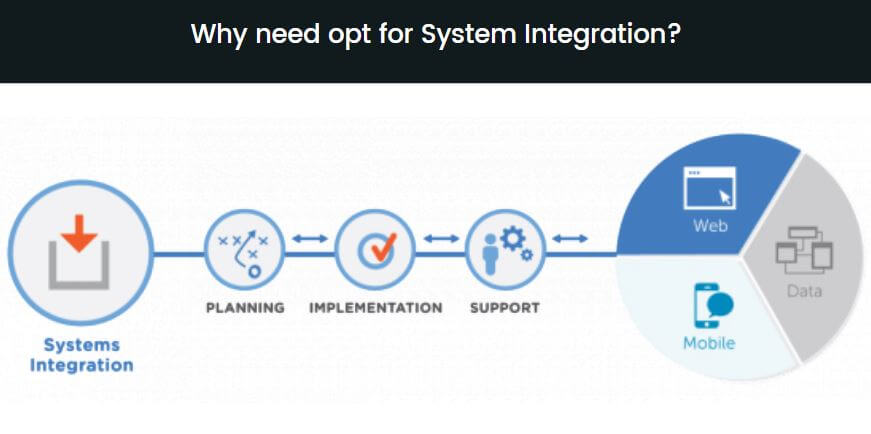
why do you need opt for system integration?

If you’re one of the few who are yet to familiarize with the concept of system integration, let’s first see,

What is system integration?

System integration is the process of integrating all the physical and virtual components of an organization into a single system.

We’re in 2020 and if you still don’t think System Integration is vital for your business, then you’re simply signing up for failure. Don’t believe it, then answer this – If your business itself is not sorted enough internally, how are you going to satisfy your customers?

In every business, there comes a point where managing all the processes like ERP, CRM, and data management becomes difficult. The main reason behind this is the use of separate tools for separate processes on separate systems. If you continue doing this,

Here’s what’ll eventually happen:

  • Data Discrepancy: As multiple processes require multiple tools; the data being generated is all over the place.
  • Wasted Manual Resources: To work on different tools, multiple resources are required.
  • Customer Attrition: Data discrepancy and resource mismanagement result in customer dissatisfaction.

How do we tackle this problem?

The answer – by implementing system integration. As the name indicates, it streamlines all your business processes by integrating all business components in a single system. If you want to explore in detail, here’s an overview of system integration services.

Now, that you’ve got a basic idea of what system integration means, let’s see in detail how it helps your business.

Why integrate your system?

  1. Optimized Business Processes 

The process of system integration is driven by communication between different computer programs via APIs. Thus, system integration basically automates all the possible business processes. Also, when you integrate your system, the information exchange between different processes also enhances.

  1. Increased ROI

The automation and optimization of business processes lead to less manual resources spent and more accurate outcomes. All in all, better ROI. So, the more efforts you put into system integration; the more ROI will be generated.

  1. Enhanced Productivity

In system integration, the access of all the business components is managed by a single system. Therefore, the hassles of accessing multiple systems with multiple authorizations are eliminated. As it takes out the unnecessary responsibilities, your resources can be more productive. 

  1. Detailed Analysis and Reporting Systems

As all the organizational data is stored in a single system, the data analysis comes out extremely thorough. And as the analysis is so detailed, the generated reporting tools are more effective. Thus, strategizing for your future business endeavors becomes easy.

  1. Smooth Workflow

The biggest benefit of the system integration process is the clear visibility that it provides you. The real-time data gives you valuable insights. The precise performance reports help you make informed decisions. Overall, system integration elevates and smoothen outs your business workflow. 

In Conclusion:

 System integration is a lucrative business enhancing tool. With a smartly integrated system, your business can achieve greater heights and stay ahead of the competition. The involvement of system integration partners only adds to the amazing benefits offered by this technology. 

Taking into consideration the needs of your business, Infonikka delivers world-class, personalized system integration solutions. At Infonikka, we offer you state-of-the-art Salesforce integration services, SAP integration services, and many more. Our integration experts guarantee successful integration not only with minimum complexities and cost but also with higher benefits and ROI.

System-Integration-services

System Integration Services: An Overview

When we talk about the society they say “It’s all about money and who’s got it the most”

Well, the same saying goes in the IT business world, only it’s not money, it’s “System Integration Service”. One of the toughest parts of the business world is to find reliable system integration services. Initially, we all have an assumption that buying individual tools rather than an entire software will be more affordable.

But..But…But, most of the times this results in detrimental outcomes which might affect the employee efficiency and these tools just might not go well together. Now, what to do? Do not worry, we will tell you! You lookout for a robust and scalable system integration solution.

We bet you have a lot of questions in your mind right now, but we ensure you will have your answers by the end of this blog! So, are you ready to breathe some fresh air of driven solutions in your organization? System integration services will do that for you!

What are system integration services?

Well, to explain precisely – System integration is a technique where all the physical and virtual entities of an organization are merged in order to unite them and make it serve as one single system.

Why is system integration important?

Although it is quite clear, let us break it down for you a little. Having a well-integrated system will offer you amazing advances in automation technology, it will streamline your processes offering you easier management.

Pro tip – Getting your system integrated is important, but more important is to have a professional system integration service provider.

What are the types of System Integration Services?

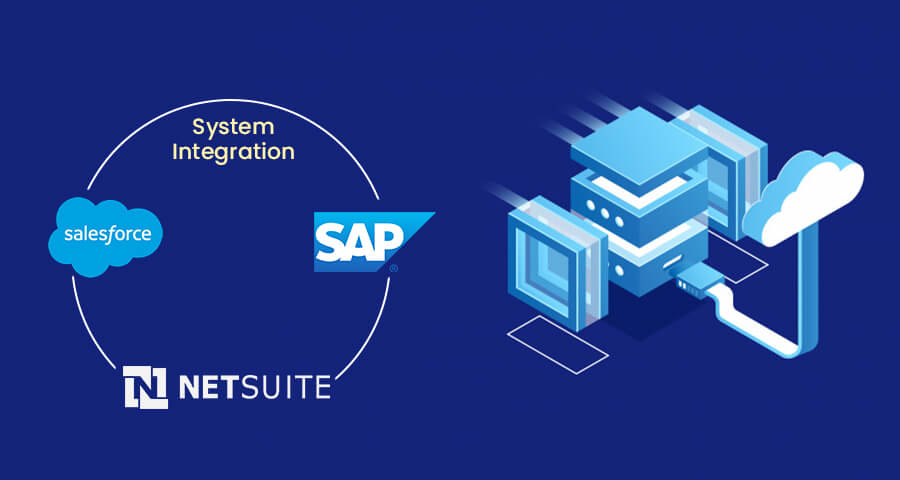
  1. Salesforce Integration Services
  2. SAP Integration Services
  3. .NET Suite Integration
  4. Data Integration Services

What are the benefits of System Integration Services?

  • Clear Visibility

Not having access to recent information can lead to a disastrous outcome. Vice-versa having all the valuable information in stunning visuals and well-built reports can help you make quick decisions. These are time-consuming tasks that need automation. Inculcating system integration solution will do this job in a smooth manner.

  • Enable efficiency

Efficiency will start boosting when your employees will focus on core business tasks. And to make this possible you can go with automation. It will not only take care of entering the data into the system without any manual help but will also eliminate the need for hiring dedicated employees for data entry.

  • Expanded sales

 It seems a simple step towards aligning your system processes but a step like a system integration plays a crucial role in enhancing your employee productivity that eventually results in sales growth. Not only your customers but your clients also get the benefits.

To sum Up

Embracing the system integration services will help you to stay ahead of your competitors. In addition, it will enhance your potential and allow you to meet the needs of your customers. With this, you can also analyze your work and spot plus and minus points to make everything better. We hope you have your answers! So, if you are ready for this amazing solution contact Continue reading “System Integration Services: An Overview”